Why Ingredient Lists Put Some Names First
Why ingredient lists put some names first: learn what order can reveal about a formula, what it cannot tell you, and how to read labels with care.
Why ingredient lists put some names first is a question with a practical answer: cosmetic ingredients are generally listed in descending order by weight, subject to rules that vary by market and ingredient category. The first few names can offer clues about a formula’s broad structure, but the list is not a recipe, a potency chart, or a ranking of benefits.
That distinction matters when comparing a moisturizer, shampoo, sunscreen, or makeup product. Position can help you read the label, but it cannot tell you exactly how much of every ingredient is present or how the finished product will behave on your skin.
What does the order usually tell you?
In many markets, ingredients are declared from the greatest amount to the least, based on weight when they are added to the product. A list that begins with water, glycerin, and a fatty alcohol, for example, suggests that those ingredients make up a larger share of the formula than ingredients farther down.
Think of the list as a row of boxes arranged from heaviest to lightest, not as a set of instructions for mixing them. A formula’s order gives a rough sense of relative quantity across much of the list. It does not disclose exact amounts, and it does not describe the manufacturing process.
Labels also use standardized ingredient names, which may look unfamiliar beside the language on the front of the package. A product called “with oat extract” may list that extract under a formal botanical name. The marketing name is designed for shoppers; the ingredient declaration serves a different purpose.
Why can the last ingredients be harder to compare?
Many labeling systems allow ingredients at or below a specified low concentration to appear in any order after the ingredients present in larger amounts. The exact convention depends on local rules. This means two ingredients near the end may not be ranked reliably against each other, even when one appears first.
Color additives can follow separate ordering conventions as well. A foundation or eye shadow may list pigments in a way that does not fit neatly into the same descending sequence as its base ingredients. When comparing color cosmetics, the shared base formula may be easier to assess than the order of every shade’s pigments.
There are also products sold in different regions, where labeling requirements can differ. A package may use a localized label or a separate ingredient panel. If the same product’s lists do not match exactly, the difference does not by itself establish that one version is stronger or better; the formula or the applicable declaration rules may differ.
How should you compare the first few names?
Start with the product’s purpose. A rinse-off cleanser and a leave-on cream have different jobs, so their opening ingredients are not a direct quality contest. In a cleanser, water and surfactants may shape how it lifts oil and rinses away. In a cream, water, emollients, and humectants may give a first impression of its base.
Then compare products intended for the same use. If a lightweight lotion and a richer cream both begin with water but differ in the next few ingredients, that can hint at different textures or formulation approaches. It cannot predict the precise feel: the finished result depends on the combination of ingredients and how they are formulated.
Say you are choosing between two leave-on moisturizers for daytime. One list begins with water, glycerin, and a light emollient; the other begins with water, a richer emollient, and a fatty alcohol. The first may be a reasonable option to explore if you prefer a lighter feel, while the second may suit someone seeking a more cushiony texture. Those are clues, not promises; a small sample or a product’s stated texture may help you decide.
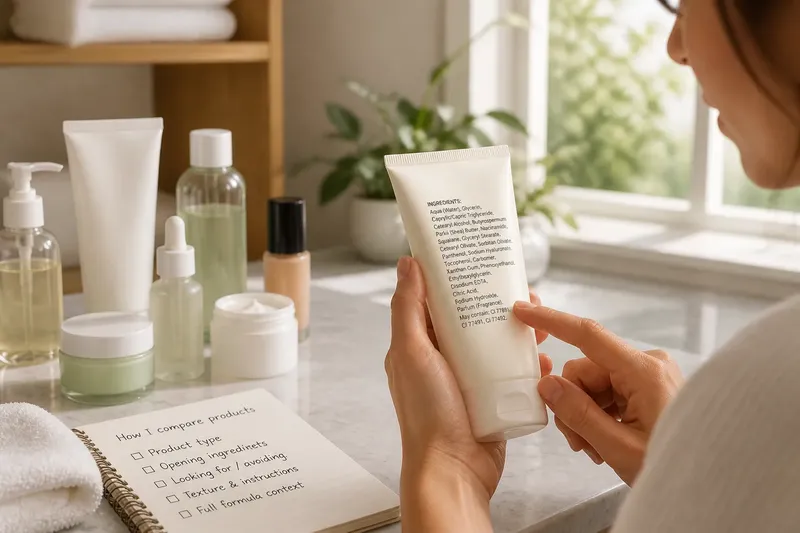
For a focused comparison, look at a few relevant features rather than trying to decode the whole list at once:
- Product type: Compare like with like, such as two moisturizers or two shampoos.
- Opening ingredients: Note the ingredients that appear before the low-concentration portion of the list.
- Ingredients you are seeking or avoiding: Check whether the relevant name appears, while remembering that position does not reveal its exact amount.
- Texture and use instructions: Read the package description and consider whether the format fits your routine.
- Full formula context: Treat one appealing ingredient as part of a blend, not as the only feature that determines the product’s effect.
What can a position not tell you?
A low position does not automatically mean an ingredient is ineffective, unnecessary, or present only for decoration. Some ingredients are used at small levels for a specific formulation role. Conversely, a name near the top is not proof that an ingredient is beneficial for every person or suitable for every skin type.
Position also does not reveal ingredient quality, source, purity, or the precise form used. A plant-derived ingredient can vary by processing and formulation. A familiar name may describe a broad class rather than one simple substance. The label is useful for identifying declared ingredients, but it cannot answer every question about sourcing or manufacturing.
Nor does order settle questions about irritation or allergy. A person can react to an ingredient present in a small amount, while another may tolerate it. If you have a known allergy, recurring irritation, or a skin condition, use the label as one part of a decision and ask a qualified health professional for advice when needed.
Which ingredient-list clues answer common questions?
Does the first ingredient make up most of the product?
Not necessarily. It is the ingredient listed in the greatest amount under the applicable convention, but the label does not give its share. The ingredient after it may be present in a similar amount or a much smaller one.
Can ingredient order show whether a product is concentrated?
Order alone cannot establish that. A product’s first ingredients describe its larger components, not a standardized measure of concentration or strength. Look for clear product claims and context rather than treating a high-ranked ingredient as proof.
Why do two similar products list ingredients differently?
The formulas may differ, even when the products have similar names or purposes. Regional labeling conventions, shade-specific colorants, or changes to a formula can also affect what appears on the package.
Can I tell how much of an ingredient is in a product?
Usually not from the ingredient list alone. Some products state a concentration separately, but the list itself generally provides order rather than exact amounts. Do not infer a precise percentage from a name’s position.
Which approach to reading suits your decision?
There are three useful ways to approach a label, depending on what you need to know.
- For a quick orientation: Read the first several ingredients to get a broad sense of the base. This suits a shopper comparing texture or product type, as long as the result is treated as a clue.
- For a targeted check: Search the full list for an ingredient you want to identify or avoid. This suits someone with a specific preference, but the name’s presence does not tell you its quantity or how the whole formula will feel.
- For a close comparison: Compare the complete lists of similar products alongside their stated uses, textures, and directions. This suits a deliberate purchase, especially when the formulas differ in more than one ingredient.
Choose the quickest approach that answers your actual question. If you are only deciding whether two creams appear to have different bases, the opening names may be enough. If you are checking for a particular ingredient, scan the whole list. If you need to judge suitability for a personal health concern, the label may not settle it.
How do rules and product claims fit together?
Ingredient order is a labeling convention, while front-of-pack claims are a separate kind of communication. A claim such as “contains ceramides” points to an ingredient’s presence but does not, by itself, show its amount or establish the product’s overall effect. The ingredient list can help confirm the declared name; it cannot supply missing context about the claim.
For any detail that depends on a label, manufacturer instructions, or local rules, check the package information for your market. That is especially useful for products whose formats or ingredients are regulated differently, including sunscreen and some color cosmetics. Do not use ingredient order as a substitute for the directions or required information on the product.
The most dependable reading habit is modest: use the first names to understand a formula’s broad outline, use the full list to find a specific declared ingredient, and leave exact concentration or personal suitability unanswered unless the product provides reliable information. Knowing why ingredient lists put some names first makes the label easier to read without asking it to say more than it does.