From Kohl to Compact: How Beauty Became Portable
Portable beauty objects show how containers shaped grooming routines, from kohl vessels to mirrored compacts, and changed what people could carry.
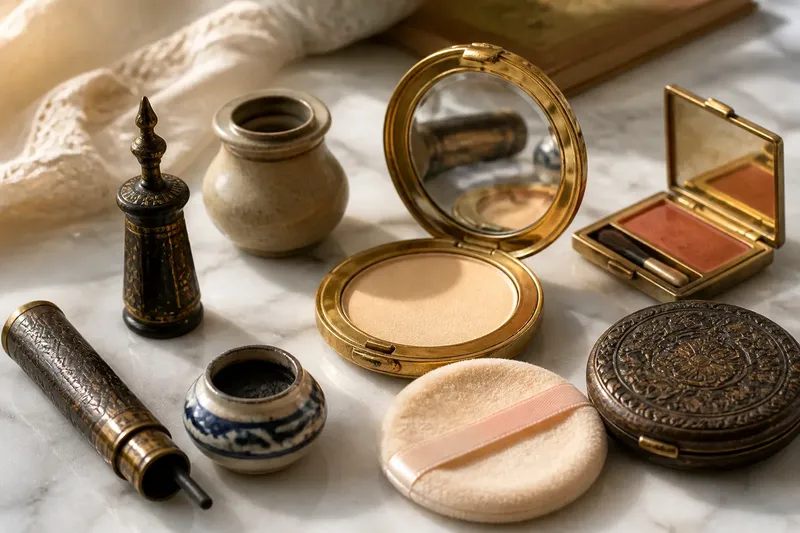
A small container can change where a grooming routine takes place. Portable beauty objects—from kohl vessels to mirrored compacts—made selected materials easier to carry, while their designs reflected how people stored and used them.
Their history is not a simple march from household ritual to individual ownership. The objects varied across cultures and periods, and their uses depended on local customs. Looking at their contents, construction, and handling offers a more careful account of how adornment moved between home and public life.
What did early portable beauty objects hold?
Before the compact became familiar, cosmetics were kept in containers suited to particular substances. Kohl, used around the eyes in different cultures and periods, could be stored in a tube, jar, or narrow vessel with an applicator. The form helped contain powder or paste and made it possible to use a smaller supply without carrying a larger household store.
These vessels did not necessarily belong to one person. They might be kept with grooming tools at home, handled by more than one person, or carried during travel. The boundary between personal possession and household object could be less distinct than it is in many contemporary routines.
Materials also shaped how a vessel was understood. Metal, stone, ceramic, or wood could be used in plain or carefully worked forms. A container might be valued for practical use, craftsmanship, or social meaning—not only for the cosmetic it held.
How did containers become part of the display?
Some grooming objects were made with polished surfaces, carving, or other decoration. In those cases, the container itself could express care, taste, or status. Beauty was present both in the substance applied to the face and in the object used to hold it.
A decorated case could attract attention when brought out, passed between hands, or kept on display. Its design also communicated something before it was opened. A grooming object carried into a shared setting had a different audience from one kept in a private room.
What changed when a mirror was added?
A mirror made the compact more self-contained. A user could check the face and apply color with one object in hand, rather than needing a separate reflective surface. Hinges and fitted interiors brought a mirror together with powder, rouge, or other small materials.
The result was a tool that could be used away from a dressing table. Whether someone used it discreetly or openly still depended on the setting and its social expectations. The attached mirror joined looking and applying in one small routine.
The interior worked a little like a desk drawer: separate spaces kept related things together. That arrangement made it easier to carry a selected set of materials, while also limiting what would fit.
How did compacts change grooming in public?
A portable mirror made touch-ups possible outside the home, but not every public setting treated visible grooming in the same way. Etiquette, class expectations, and ideas about privacy shaped when a compact could be used and how openly. The object offered a practical option; social rules influenced whether using it felt appropriate.
Imagine a traveler carrying a plain hinged case with a mirror and a small cake of face powder. Before meeting a group, she opens it to check a smudge, sees that the powder has transferred near her cheek, and uses the mirror to remove it before closing the case. The observable result is a cleaner cheek and no need to find another reflective surface; the tradeoff is that the brief adjustment may still draw attention in a setting where grooming is expected to remain private.
What do compact designs include, and what do they leave out?
Limited space makes a case shape the routine it carries. Compartments, removable pans, and fitted applicators can keep selected materials together, while leaving little room for extras. A compact therefore does more than store products: its layout favors some actions over others.
Pressed powder in a pan is easier to contain in a small case than loose powder in a jar. A mirror attached to the lid changes how the case is held, while a clasp and hinge affect how it opens and closes. Protection, access, and appearance all depend on how the shell and contents work together.
Why did compact cosmetics become personal consumer goods?
By the late nineteenth and early twentieth centuries, expanding commercial production and retail sales were making factory-made cosmetics and purpose-built cases more visible in many markets. The change was gradual and uneven, not a single shift that applied everywhere. A compact could be sold as a finished product, with a cosmetic fitted into its case, rather than assembled around a household supply.
Branding and packaging made these objects recognizable as consumer goods. Some cases were designed for refills or replacement contents; others were kept after the original cosmetic was gone. Buyers could choose among products for their function, appearance, or brand identity, making the case part of how a product presented itself.
Personal ownership did not end sharing. Someone could lend a mirror, offer a cosmetic, or pass a case to another person. The compact’s portability made it convenient to carry, but its meaning still depended on how people used and exchanged it.
What questions help explain portable beauty objects?
What is the difference between a vessel and a compact?
A vessel usually stores a particular substance, while a compact typically combines a case with a cosmetic and often a mirror. The distinction is useful, though historical objects and uses do not always fit a neat category.
Why were some portable containers decorated?
Decoration could make an object pleasing to handle or display and could signal craftsmanship or social meaning. It did not necessarily make the container more useful or tell us exactly who owned it.
Did portable grooming always happen in public?
No. A carryable object could remain at home or be used in private settings. Its portability made other uses possible, but local customs and personal preference shaped where it was actually used.
How can modern packaging echo the compact?
Refillable cases, travel mirrors, and slim palettes retain the compact’s basic design problem: keeping selected materials together, protecting them, and making them usable away from a fixed grooming space. Their resemblance is a design comparison, not evidence that every modern product descends directly from a historical compact.
What can the compact tell us about beauty culture now?
Portable beauty objects help separate a product’s function from its cultural message. A container may protect a cosmetic, while its materials, finish, and use suggest who it is for or where it belongs. Those suggestions vary with local customs and with the meanings attached to particular objects and gestures.
The compact’s history is best understood as a record of changing boundaries rather than a straight path toward convenience. From kohl vessels to mirrored cases, portable beauty objects changed what could be carried and where grooming could take place. They also show how design can shape a routine without determining exactly how anyone will use it.